
In a nutshell
The SWAG project is a multidisciplinary initiative in the field of soft robotics, focusing on the development of lower limb exosuits: soft wearable exoskeletal robots to empower the lower body and core.
The project aims to replace traditional rigid materials found in exoskeletons, with high-strength, inflatable fabrics and sensing films to create smart, human-assistive, soft and lightweight garments. The envisioned exosuits will ensure user comfort and safety, while remaining virtually undetected, invisible under clothing due to their garment-like design.
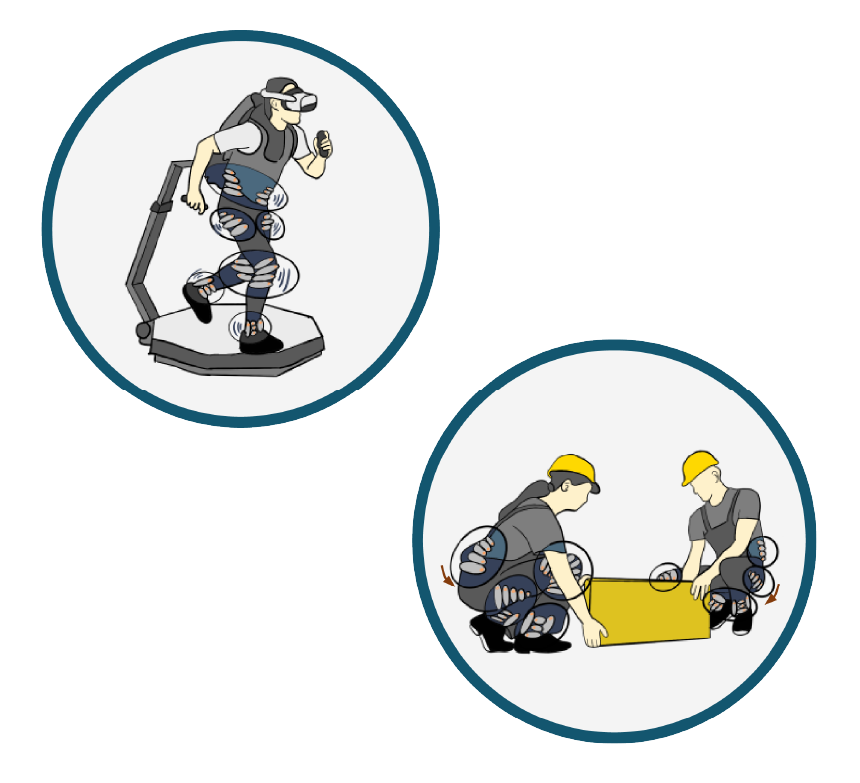
SWAG exosuits will empower humans in activities from occupational assistance to daily mobility, fitness and immersive entertainment.
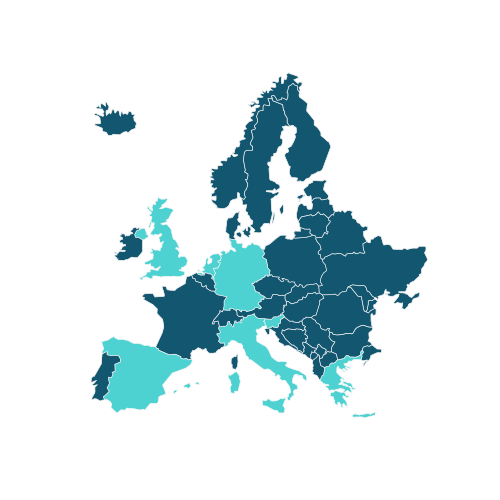
SWAG involves 13 partners from six EU countries and the UK, including leading academics, Research and Technology Organisations and two commercial partners.


Consortium
-
 Greece is represented by Tech Hive Labs (THL), the project coordinator, the Hellenic Mediterranean University (HMU) and Bendabl (BBL)
-
 Germany is represented by RUPRECHT-KARLS-UNIVERSITAET HEIDELBERG (UHEI).
-
 Italy is represented by SCUOLA SUPERIORE DI STUDI UNIVERSITARI E DI PERFEZIONAMENTO S ANNA (SSSE) and IUVO SRL (IUVO).
-
 Spain is represented by FUNDACIO EURECAT (EUT).
-
 Slovenia is represented by the INSTITUT JOZEF STEFAN (IJS).
-
 The Netherlands are represented by UNIVERSITEIT TWENTE (UOT) and ROESSINGH RESEARCH AND DEVELOPMENT BV (RRD).
-
 The UK is represented by THE UNIVERSITY OF HERTFORDSHIRE HIGHER EDUCATION CORPORATION (HE), BRUNEL UNIVERSITY LONDON (BUL) and IMPERIAL COLLEGE OF SCIENCE TECHNOLOGY AND MEDICINE (ICL).
The challenges
SWAG will revolutionize the field of human motion assistance by eliminating challenges that are currently blocking progress

User comfort and efficiency
Existing wearable robots use heavy and bulky devices to assist isolated joints. The increased weight of the robotic components leads to increased metabolic costs and reduces the device’s energetic efficiency. Another common issue is the activation of specific joints, overlooking the overall impact on the full-body biomechanics. Moreover, current wearable solutions struggle to conform to an individual’s physiology, and to adjust to each user’s unique motion needs during various daily activities.
Pneumatic actuation
Pneumatically powered exosuits offer a solution to the weight problem, allowing the use of inflatable, high-strength fabrics that can easily transform to stiff supporting structures via internal pressurization. However, pneumatic systems generally struggle with their power supply, as suitable portable pneumatic sources are not available, and only traditional air compressors have been used in past solutions, which are not practical, for various reasons.
Data acquisition and processing
Soft sensors have been developed to address the needs of soft systems, tracking pressure, strain, force and contact interactions. Soft sensing technologies and computational algorithms have advanced in collecting data from various sources in controlled settings and specific activities. However, these soft approaches face challenges in consistently functioning in real-world situations, across different applications and securely responding to unexpected inputs and interactions.
SWAG solutions
In order to address these challenges and transform soft wearable robotics, SWAG will make advances in fabric-based soft robotics, integrated sensing, user intent tracking, and distributed actuation. Our goals include:
-

Introducing a new design approach for wearable robots based on adaptability and human-centric design. This involves using optimized inflatable fabrics to cover and support entire body regions, not just individual joints.
-
Providing personalized real-time motion assistance using a combination of distributed sensing, control, and user-intent prediction algorithms based on data-driven models. This ensures accurate and adaptive support for various movements.
-
Eliminating the need for tethered operation and simultaneously supporting muscles and joints throughout the entire lower limb system. This is made possible by a single pneumatic source and a closed pneumatic circuit efficiently recycling air.
-
Overcoming the limitations of wearable devices by adopting a multidisciplinary approach that combines soft design, embedded sensing, functional apparel, smart textile design, biomechanical modeling, materials science, distributed control; with AI at the centre.
Contact Us
Email: swag@coo.twi.gr