
SWAG at ADRF25: Human‑centred AI and wearable robotics for reducing manual labour strain
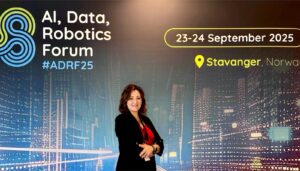
On 23 September 2025, SWAG joined the AI, Data and Robotics Forum 2025 (ADRF25) in Stavanger, Norway as part of a MANiBOT‑led workshop exploring how advanced robotics and AI can reduce the physical strain of manual labour. While ADRF25 spans a broad set of themes across robotics, AI and deployment, the session provided an excellent opportunity to connect robotic manipulation, industrial needs, and wearable support technologies in a single, human‑centred discussion.
Workshop focus
The workshop “Pushing the limits of robotic and AI technologies for advanced object manipulation towards reducing human labour” was organised by MANiBOT partners and brought together perspectives spanning:
- Bimanual mobile manipulation for robust object handling in dynamic environments
- Perception and sensing approaches that enable safe operation around people
- Occupational exoskeletons and wearable support, aimed at reducing ergonomic strain
- End‑user perspectives from logistics and baggage‑handling workflows
The discussion reinforced a shared message across projects: impactful innovation happens when systems are designed to augment human capability, improving safety, ergonomics and productivity, rather than trying to replace the human worker.
SWAG contribution: making assistance work in real workplaces
Within this workshop context, SWAG (represented by IUVO ; Dr. Ilaria Pacifico) presented a simple question:
How do we keep assistance effective and “in phase” with the worker, the task and the environment in real industrial conditions?
The message was structured in three parts:
1) Why exoskeletons matter
Work‑related musculoskeletal disorders remain a major challenge in manual labour. Drivers include awkward postures, repetitive upper‑limb movements, and heavy lifting, affecting diverse workforces across age groups and roles.
2) Where the market is today
In industrial settings, passive exoskeletons are currently the dominant product category. They are lightweight, battery‑free, straightforward to train and maintain, and typically easier to integrate with PPE and existing work processes. IUVO shared field experience from deployments of passive systems, including MATE XT and MATE XB across logistics, assembly, cleaning and cargo use cases, with consistent reductions in muscular and perceived effort, alongside solid usability and acceptance.
3) The gap to bridge
Industrial environments change continuously: people rotate, tasks vary, and workspace constraints shift hour by hour. When assistance cannot adapt, benefits can diminish. Between what is technically feasible in the lab (active/soft systems with rich sensing) and what scales reliably on the shop floor (often passive devices), there is a practical barrier shaped by comfort, acceptance, workspace interference, integration, certification, and site readiness.
Where AI becomes a step change
SWAG is addressing this barrier by pairing soft actuation with on‑body sensing and intent‑aware, co‑adaptive control, aiming to keep support synchronised with the user and the task while remaining compatible with real operational constraints.
What the audience wanted to know
The ADRF25 audience was pragmatic and highly engaged, with questions focused on “deployment reality”, including:
- how AI‑driven assistance affects comfort and acceptance over long shifts
- whether wearable systems interfere with workspaces, tools and movement constraints
- what it means to make a site “AI‑ready”, including minimal sensing strategies and data/privacy governance agreed with HSE and aligned with GDPR
Cross‑project exchange with MANiBOT
A key outcome of the session was the value of connecting robotic automation with wearable augmentation. The exchange with MANiBOT partners helped link advances in robotics with worker‑centred deployment realities, supporting a broader view of how complementary technologies can reduce strain and improve workforce health and well‑being.
Links & resources
- ADRF25 official site: https://adrforum.eu/
- ADRF25 workshops overview (includes the MANiBOT workshop listing): https://adrforum.eu/workshops-overview
- MANiBOT project: https://manibot-project.eu/