
A Unified Framework for Soft Inflatable Fabric Actuators
A newly published study, “A Unified Framework for Soft Inflatable Fabric Actuators”, by Odysseas Simatos, Konstantina Tsintzira, Grigorios M. Chatziathanasiou and Panagiotis Polygerinos from SWAG partner Hellenic Mediterranean University, presents a major step forward in how soft inflatable fabric actuators can be designed and understood.
Soft inflatable actuators are lightweight and safe, but their behavior can be difficult to predict, as small design changes often lead to large performance differences. This study presents a simple and general method that allows engineers to predict actuator behavior before fabrication. As a result, soft wearable robots can be designed more reliably and efficiently, without relying on trial-and-error approaches.
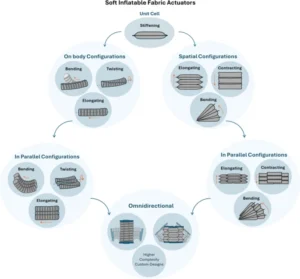
Key takeaways
- Unified modeling framework: Introduces a single, analytical framework that captures the behavior of a wide range of soft inflatable fabric actuators, with the stiffening actuator servingas the fundamental unit cell.
- Design generality and scalability: Demonstrates that actuator performance can be predicted across key design parameters such as the chamber numbers, sizes, and operating pressures, enabling systematic scaling from small prototypes to large-scale systems.
- Reduced trial-and-error design: Replaces empirical tuning with physics-based design rules, significantly shortening development time and improving reproducibility.
- Experimental validation: Validated through extensive experimental characterization across multiple actuator configurations, showing consistent agreement with the proposed model.
- Application-driven design: Provides designers of soft robots with practical guidelines for selecting actuator parameters to meet application-specific force, displacement, and pressure requirements in soft robotic systems.
This research serves as a foundational pillar for the SWAG project’s mission to develop the next generation of soft wearable assistive garments. By providing a standardized mathematical and experimental framework, this work allows the transition from “trial-and-error” prototyping to a predictable, design-driven approach. This supports the systematic optimization of inflatable fabric actuators for lower-limb exosuits, balancing high assistive performance with human-centric design.
The paper has been published in Scientific Reports 15, Article number: 41629 (2025) , read it here