
SWAG hosted hands-on workshop on CEINMS-RT
On 29 October 2025, SWAG hosted an online hands-on workshop dedicated to CEINMS-RT, an open-source platform for real-time neuro-mechanical model-based control of wearable robots. The session focused on how the platform can be used to support wearable robotic systems such as exoskeletons, exosuits, and bionic limbs.
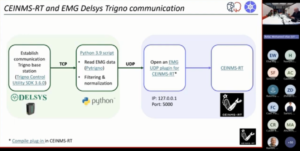
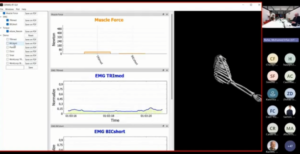
The workshop offered a practical walkthrough of CEINMS-RT, presenting both the logic behind the platform and the way it can be used in real-time wearable robotics applications. Participants were taken through the framework’s architecture and then shown a live end-to-end demonstration, following the full pathway from EMG and sensor acquisition to real-time assistive output. The session also included a guided installation segment and a Q&A, giving attendees a clearer understanding of how the platform can be implemented and explored in research and development settings.
The workshop featured Prof. Massimo Sartori, Michele Paravano, Mohamed Irfan Refai, Roger van Kanten, and Salvatore Li Gioi. Credit goes to the Neuromechanics and Neuromuscular Robotics Lab at the University of Twente for the development of CEINMS-RT and for delivering the workshop. The platform was developed within SWAG by researchers at the University of Twente, led by Prof. Massimo Sartori, in collaboration with McGill University and Griffith University.
CEINMS-RT was launched at the start of 2025 as a freely available open-source platform. Its aim is to support more personalised and adaptive control of wearable robots by combining real-time EMG data with biomechanical modelling to estimate quantities such as muscle activation, muscle–tendon force, and joint dynamics.
By bringing together researchers, developers, and the wider wearable robotics community, the workshop offered a valuable opportunity to explore how open-source neuromechanical modelling can support real-time assistive technologies and future applications in rehabilitation, augmentation, and human-centred robotics.
Useful links
- Watch the workshop recording on YouTube
- Read the SWAG feature on CEINMS-RT
- CEINMS-RT documentation
- CEINMS-RT GitHub organisation
- TechRxiv preprint
Funding acknowledgement
The SWAG project has received funding from the European Union’s Horizon Europe research and innovation programme under Grant Agreement No. 101120408. The views and opinions expressed are those of the authors only and do not necessarily reflect those of the European Union or the European Commission. Neither the European Union nor the granting authority can be held responsible for them.