
SWAG at IROS 2026: Highlights from the 1st Workshop on Neuromuscular Robotics
1 October 2026 | Pittsburgh, USA
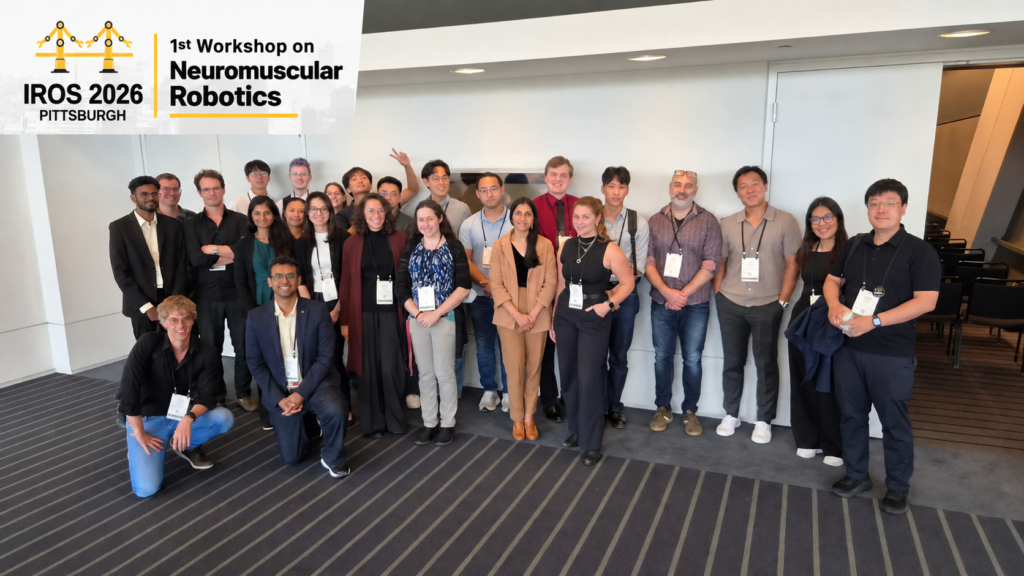
How can a robot recognise when to assist a movement, how much support to provide, and when to let the person take the lead?
Questions like these connect the science of human movement with the engineering of wearable robots. They also provided the context for the 1st Workshop on Neuromuscular Robotics, held at IEEE/RSJ IROS 2026 in Pittsburgh. Supported by SWAG, the workshop brought together researchers from neuroscience, biomechanics, robotics and bioengineering to explore how a deeper understanding of the human neuromuscular system can inspire more adaptive robotic technologies.
SWAG partner the University of Twente contributed to the organisation through Massimo Sartori, Vasileios Trikalitis and Mohamed Irfan Refai, working alongside colleagues from ETH Zürich, the Massachusetts Institute of Technology and the University of Tokyo. The collaboration brought different research perspectives into a shared conversation about the relationship between biological movement and robotic design.
Understanding movement and translating it into robotics
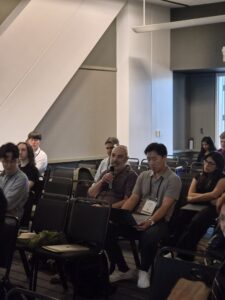
The programme approached neuromuscular robotics from two complementary directions. The first focused on understanding human neuromuscular control and developing interfaces between people and technology. The second explored how these insights can inform muscle-driven and biohybrid robotic systems. Connecting the two meant looking beyond what a robot can do mechanically to consider how its behaviour can be informed by the way movement is generated and controlled in the body.
Invited speakers included Gregory Sawicki from Georgia Tech, Victoria Webster-Wood from Carnegie Mellon University, Shriya Srinivasan from Harvard University and Vanessa Sanchez from Rice University, among others. Their inclusion reflected the workshop’s breadth, bringing researchers from different institutions and areas of expertise into the same programme.
The exchange continued through poster presentations and the closing roundtable. In their reflections after the event, the organisers highlighted the stimulating discussions and the new collaborations and research directions that emerged. This was a first edition built around conversation as well as presentation: an opportunity to share work, compare approaches and identify questions worth pursuing together.
Why this matters for SWAG
For SWAG, the connection is practical. The project aims to develop soft, lightweight assistive garments for the lower body and core, replacing rigid exoskeletal structures with inflatable fabric-based components. These garments are intended to support activities ranging from everyday mobility and occupational tasks to wellness training and immersive entertainment.
But making a wearable robot softer is only part of the challenge. Its assistance also needs to respond appropriately to the person wearing it. SWAG’s approach therefore connects garment and actuator design with sensing, biomechanical modelling and adaptive control, so that information about the wearer’s movement can guide the system’s response.
The University of Twente’s contribution centres on personalised musculoskeletal models driven by electrical signals from muscles, measured through electromyography, or EMG. These models are designed to estimate joint torque and stiffness in real time and inform exosuit control. In practical terms, the aim is to use information about the wearer’s own muscle activity to help determine how the garment provides support.
This gives SWAG a direct stake in the workshop’s central question: how can knowledge of human neuromuscular function be translated into robotic assistance that responds to the individual, rather than treating every movement and every wearer in the same way?
Recognising outstanding poster contributions
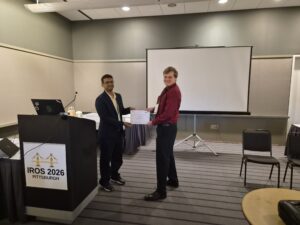
The poster session gave emerging ideas and ongoing research a prominent place in the programme. Short flash presentations introduced the projects, opening the way for more detailed exchanges between participants and authors. The award-winning work spanned topics including learning-based models of standing balance, implantable actuation for musculoskeletal assistance, and approaches combining neural networks with musculoskeletal models to control upper-limb prostheses.
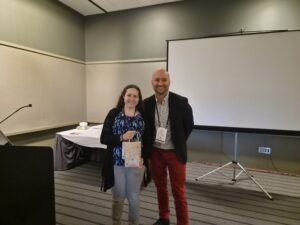
Maria Tagliaferri, from Carnegie Mellon University, received first place, followed by Chenghao Xing, from Penn State University, in second place. Eric Weismann, from Arizona State University, received third place, while John Patterson, from North Carolina State University, was awarded fourth place. The organisers praised the quality of the submissions and thanked all poster contributors for sharing their work.
Continuing the conversation
The organisers closed their reflections with the hope of welcoming the community to a future edition. For SWAG, the workshop’s focus offers a valuable point of connection between understanding the body and designing technologies that work with it.
SWAG congratulates the poster award recipients and thanks the organisers, speakers and participants for contributing to this first edition. We look forward to continued exchanges across the human movement and robotics communities.
Explore further details and photographs from the event on the official workshop website here