
SWAG joins European robotics projects for the TORNADO Technical Exchange
On 17 September 2026, SWAG took part in the TORNADO Technical Exchange Session – Cluster Projects Meeting, bringing together seven European robotics projects to share their technical approaches, compare challenges and explore opportunities for further collaboration.
The online exchange connected TORNADO, PRIMI, MANiBOT, AEROSUB, ROB4GREEN, ARISE and SWAG projects developing robotic technologies for very different applications, but confronting many of the same fundamental questions.
How can robots adapt when the environment or task changes? How can sensing be translated into meaningful action? How can robotic systems interact safely and effectively with people? And how can advances in individual components be successfully brought together into reliable, intelligent systems?
For SWAG, these questions are particularly relevant. Although the project focuses on soft wearable robotics rather than conventional robotic manipulators, its ambition similarly depends on bringing perception, sensing, modelling and adaptive control together around one highly complex and constantly changing element: the human body.
A common challenge: making robotics more adaptive
A key theme emerging from the exchange was the move away from robotic systems that depend on rigid, predefined behaviours.
Real-world robotics rarely takes place under perfectly predictable conditions. Objects change, environments change and – in the case of wearable robotics –people move differently, have different bodies and perform different activities.
This makes adaptability central to the next generation of robotic technologies.
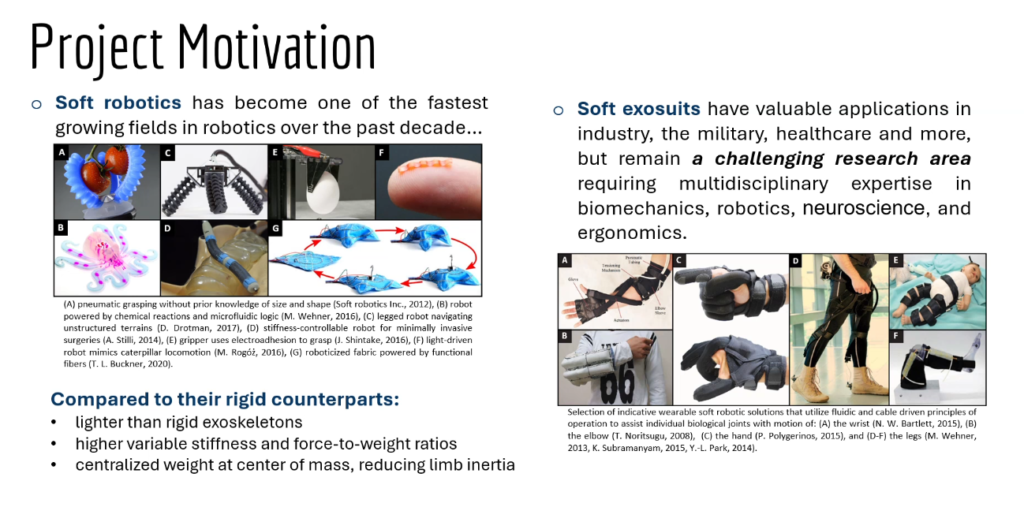
For SWAG, adaptability begins with the design of the wearable system itself. The project is developing soft robotic garments based on high-strength inflatable fabrics, moving away from the rigid structures commonly associated with traditional exoskeletons.
The aim is not simply to make an exoskeleton lighter. SWAG is investigating how soft structures can conform to the body, support complex joint motion and deliver assistance while maintaining the comfort and freedom of movement expected from a garment.
But mechanical flexibility is only one part of the challenge.
A wearable robot also needs to understand what its user is doing ,and what they intend to do next.
From wearable sensing to intelligent assistance
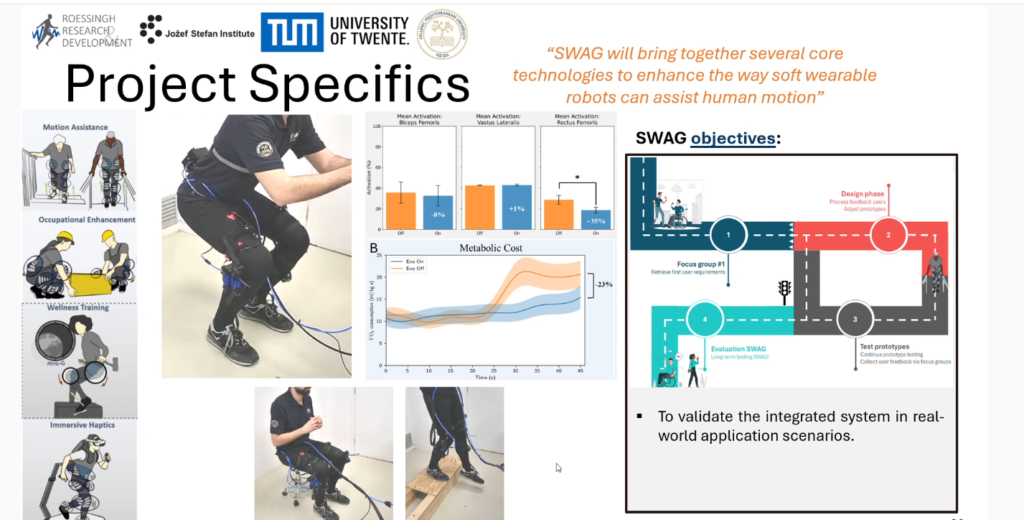
This is where SWAG’s work on smart textiles, embedded sensing, biomechanical modelling and adaptive control becomes particularly important.
Sensors integrated into the wearable system collect information about the user and the behaviour of the robotic garment. These signals can then contribute to models of human movement and ultimately to the control strategies governing the assistance provided by the exosuit.
Rather than relying on a fixed pattern of support, the long-term objective is a system capable of responding dynamically to the person wearing it.
SWAG is therefore exploring a layered approach in which sensing, biomechanical understanding, AI-supported user-intent estimation and distributed control work together.
The challenge is considerable: assistance needs to arrive at the right moment, at the right joint and with the appropriate level of force, while remaining comfortable, safe and responsive to individual users.
This human-in-the-loop dimension offered an interesting complement to many of the manipulation and autonomous robotics approaches presented during the TORNADO exchange.
Physical intelligence takes different forms
One of the most valuable aspects of cross-project meetings is seeing how similar research questions emerge in apparently very different robotic systems.
For a manipulation robot, physical intelligence may involve recognising an unfamiliar object, selecting an appropriate grasp and adapting when contact does not occur as expected.
For a wearable robot, the same broader principle takes a different form.
The robot must interpret information generated through interaction with the wearer and continuously adapt the assistance it provides as movement unfolds.
In both cases, sensing alone is not enough. The real challenge lies in turning sensory information into useful decisions and then translating those decisions into appropriate physical action.
This connection between sensing, interpretation and control was one of the areas where the projects participating in the technical exchange found clear common ground.
The integration challenge
The discussions also reinforced another important lesson for advanced robotics: impressive individual technologies only become truly useful when they can operate successfully as part of a complete system.
This is particularly relevant as SWAG moves towards increasingly integrated prototypes.
Its soft actuators, textile structures, embedded sensors, portable pneumatic technologies, electronics, biomechanical models and control algorithms cannot operate as isolated developments. They ultimately need to function together as one wearable robotic system.
Integration therefore raises questions that extend beyond the performance of any single component.
Can sensors provide sufficiently reliable information during movement? Can the control system respond quickly enough? Can the pneumatic system provide the required assistance while remaining portable? Can the garment accommodate different users while keeping actuators correctly positioned? And, crucially, does the complete system provide assistance in a way that feels natural and useful to the person wearing it?
These are precisely the kinds of challenges that benefit from exchange between projects at different stages of robotic system development.
From the laboratory to human-centred applications
SWAG’s technologies are being developed with several very different application scenarios in mind.
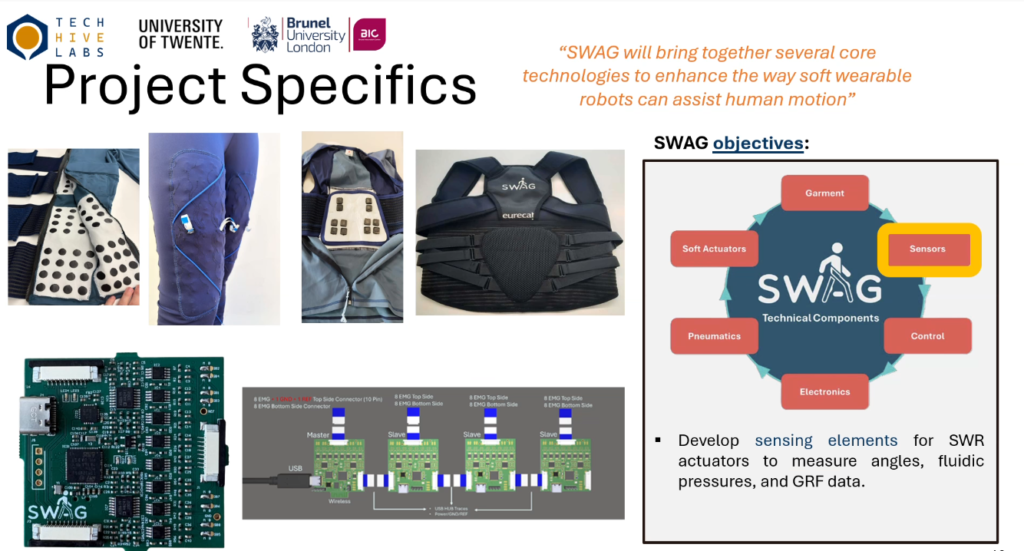
The project is exploring soft wearable robotics for mobility assistance, helping people perform activities of daily living; occupational support, reducing physical strain during demanding work; wellness and physical training, where robotic resistance could support new approaches to exercise; and immersive haptics, where the garment can become an interface between physical movement and virtual environments.
While these applications differ substantially, they share the same core requirement: the technology must adapt to the person rather than expecting the person to adapt to the technology.
This makes human-centred design, continuous user involvement and consideration of safety, usability and acceptability integral to SWAG’s development process.
Why cross-project technical exchanges matter
European research projects often investigate different applications while developing technologies that overlap in important ways.
Meetings such as the TORNADO Technical Exchange create an opportunity to look beyond individual project boundaries and identify those intersections.
Different projects may be working on perception, force interaction, learning, sensing, control, human–robot collaboration or system integration from very different starting points. Bringing these perspectives together can reveal complementary approaches, highlight common technical bottlenecks and open the door to new exchanges between research teams.
For SWAG, participation also contributes to the project’s wider effort to connect with the European robotics ecosystem and build links with initiatives advancing physical intelligence, human-centred robotics and adaptive robotic systems.
Towards more responsive human–robot systems
Robotics is increasingly moving beyond machines that simply execute predefined commands.
Whether the robot is manipulating an object, navigating an uncertain environment or being worn directly on the human body, future systems will need to sense, interpret, adapt and respond.
SWAG approaches this challenge through soft wearable robotics: combining functional textiles, soft actuation, sensing, biomechanics and intelligent control to investigate robotic systems that can work in much closer physical coordination with people.
The TORNADO Technical Exchange provided another opportunity to place that work within a broader European research landscape — and to explore how different routes towards physical intelligence can inform one another.
As the participating projects continue to advance their technologies, exchanges of this kind can help turn parallel research efforts into a more connected European robotics community.