
From Smart Textiles to Personalised Gait Assistance: SWAG at IEEE EMBC 2026
29 July 2026 | Toronto, Canada | IEEE EMBC 2026
What if wearable robots could feel more like clothing, understand how we move and provide assistance tailored to our individual needs?
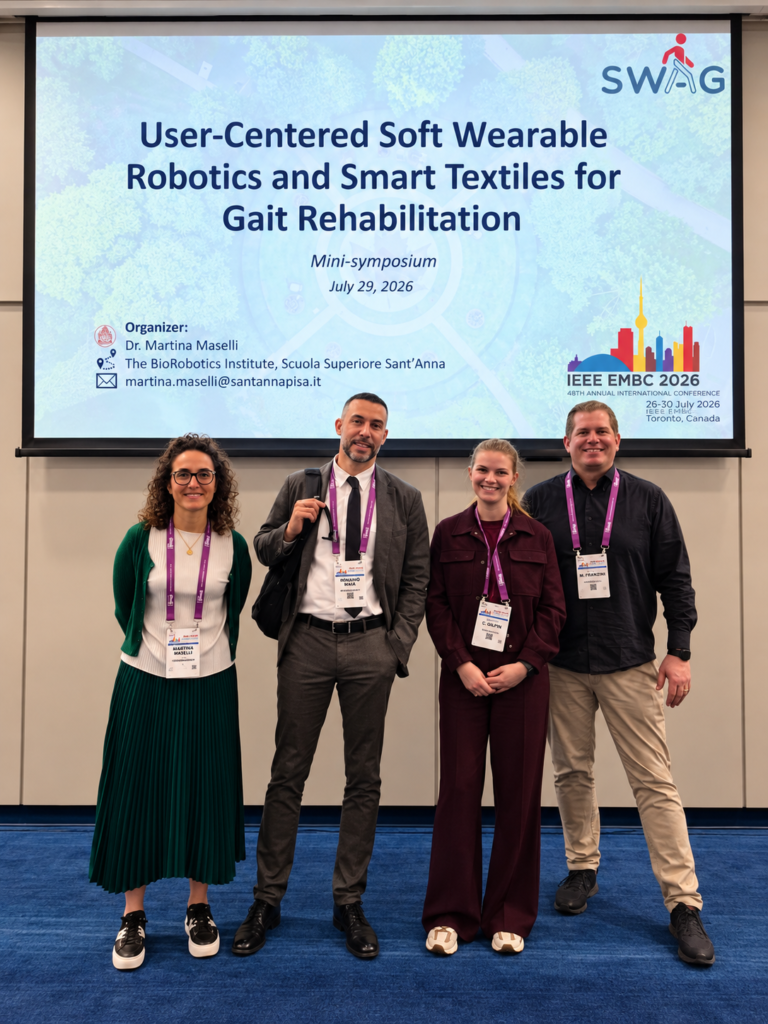
This vision was at the heart of the SWAG mini-symposium, “User-Centered Soft Wearable Robotics and Smart Textiles for Gait Rehabilitation”, held on 29 July 2026 during the IEEE Engineering in Medicine and Biology Conference (EMBC 2026) in Toronto, Canada.
Organised and chaired by Martina Maselli from The BioRobotics Institute at Scuola Superiore Sant’Anna, the 90-minute session (11:30–13:00, Room 705) brought together four researchers from the SWAG consortium to explore how advances in soft robotics, smart textiles, intelligent control and clinical biomechanics could contribute to the next generation of wearable technologies for gait rehabilitation, particularly following a stroke.
Aligned with the conference theme, “Engineering Sustainable and Equitable Healthcare”, the symposium addressed a fundamental question: How can we translate sophisticated robotic technologies into practical, personalised solutions that genuinely respond to people’s needs?
Rethinking wearable robotics: assistance that adapts to the person
Conventional robotic exoskeletons have demonstrated considerable potential for movement assistance and rehabilitation. However, their mechanical structures can present challenges in terms of weight, comfort and adaptability, particularly when considering prolonged or everyday use.
The SWAG project is exploring an alternative approach.
By combining inflatable fabric actuators, embedded soft sensors, smart textiles and intelligent control, SWAG aims to develop lightweight, garment-like robotic systems that conform to the human body and provide adaptive support during movement.
Rather than requiring users to accommodate the mechanics of a robotic device, SWAG seeks to develop technologies that accommodate the individual: their movement patterns, physical capabilities and everyday needs.
The mini-symposium examined this ambition from four complementary perspectives, connecting technological innovation with clinical understanding and user-centred design.
Making wearable robots smarter, softer and more responsive
Lorenzo Masia, from the Technical University of Munich , explored the potential of intelligent control in his presentation, “Adaptive Control of Soft Wearable Robots Through Machine Learning and Vision-Based Sensing”.
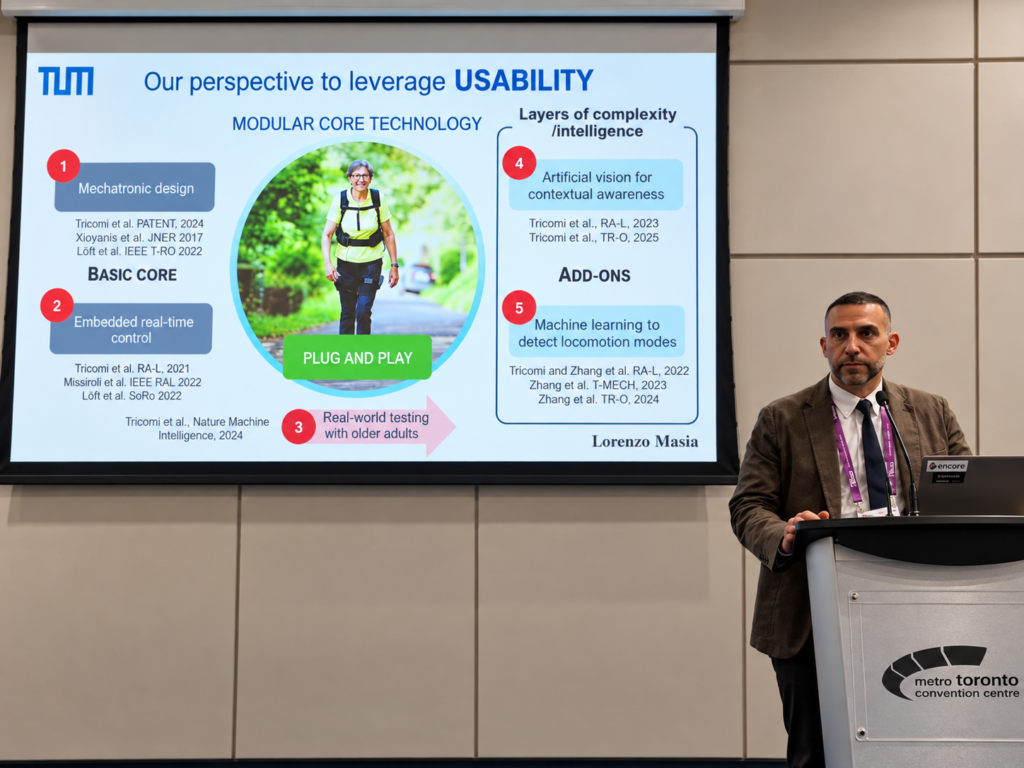
His contribution addressed one of the key challenges in wearable robotics: enabling a device to respond to human movement rather than simply following predefined assistance patterns.
Machine learning and vision-based sensing offer promising approaches for interpreting movement and informing adaptive control strategies. These capabilities are particularly relevant given the variability of human gait and the need for assistance that can adjust to different users and changing conditions.
But intelligent control depends on something equally important: reliable information about what is happening between the wearer and the robotic system.
This connection between sensing and robotic response was explored by Martina Maselli, from The BioRobotics Institute at Scuola Superiore Sant’Anna in Pisa.
Her presentation, “Soft and Textile-Integrated Sensors for Human–Robot Interaction in Wearable Robotics”, examined how sensing technologies can be incorporated directly into fabrics, transforming wearable materials into interfaces capable of gathering information about human movement and physical interaction.
The discussion covered sensor materials, fabrication methods and integration into garments, alongside practical challenges such as robustness, washability and long-term stability.
These considerations are essential for moving beyond laboratory prototypes. A wearable robotic system must not only capture meaningful information but also remain comfortable, functional and reliable during repeated use.
Together, the two presentations highlighted how intelligent control and textile-integrated sensing can work hand in hand, supporting SWAG’s ambition to develop more responsive and personalised wearable assistance.
Understanding gait after stroke: where clinical needs guide engineering
Advanced technology alone does not guarantee meaningful rehabilitation outcomes. To design effective assistance, researchers must first understand the movement difficulties experienced by the people who will use it.
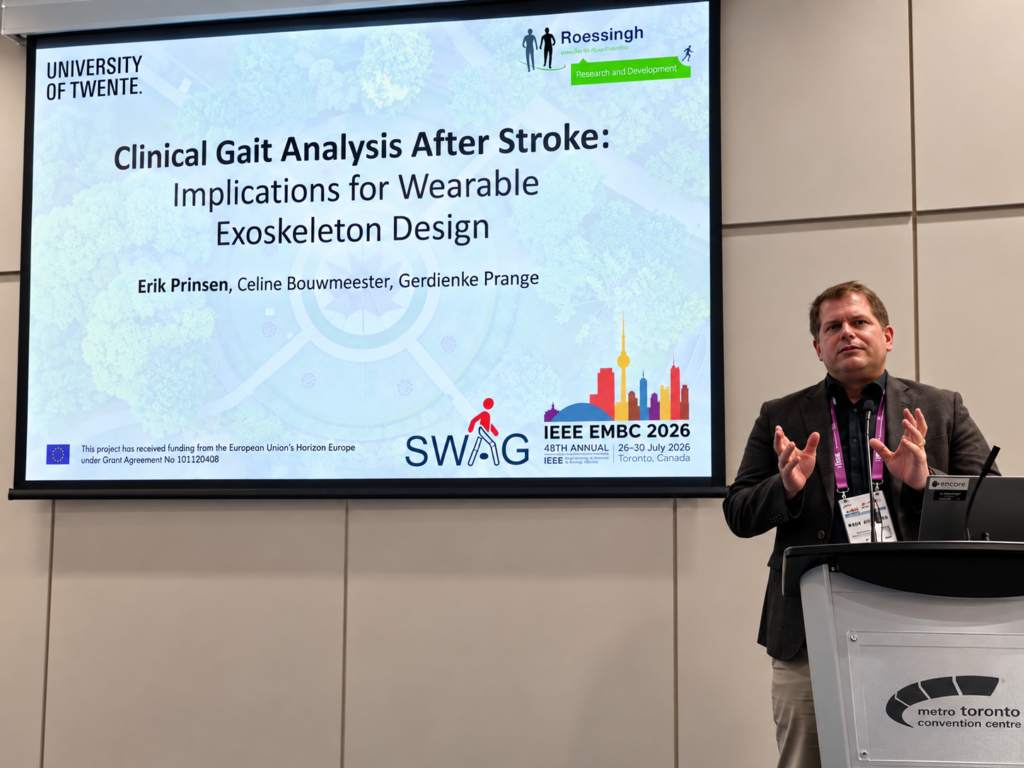
This clinical perspective was provided by Erik Prinsen, from Roessingh Research and Development and the University of Twente, in his presentation, “Clinical Gait Analysis After Stroke: Implications for Wearable Exoskeleton Design”.
Walking after a stroke can involve complex and highly individual changes in movement. Difficulties such as reduced ankle push-off or impaired knee flexion may affect walking efficiency and mobility, but the nature and severity of these impairments vary considerably.
Clinical gait analysis helps identify these differences, providing valuable information for defining the functional requirements of assistive devices.
For wearable robotics, this means moving beyond a general concept of movement assistance towards personalised, deficit-specific support, informed by the actual biomechanical needs of the individual.
This connection between clinical assessment and engineering design is central to SWAG’s ambition to develop technologies that are not only mechanically capable but also relevant to real rehabilitation challenges.
Designing with users, not just for them
The human-centred dimension of SWAG’s research was brought into focus by Celine Bouwmeester, also from Roessingh Research and Development and the University of Twente.
Her presentation, “Co-Designing Soft Wearable Robotics: A User-Centered Approach for Personalized Gait Assistance”, explored the importance of involving users, clinicians and engineers throughout the development process.
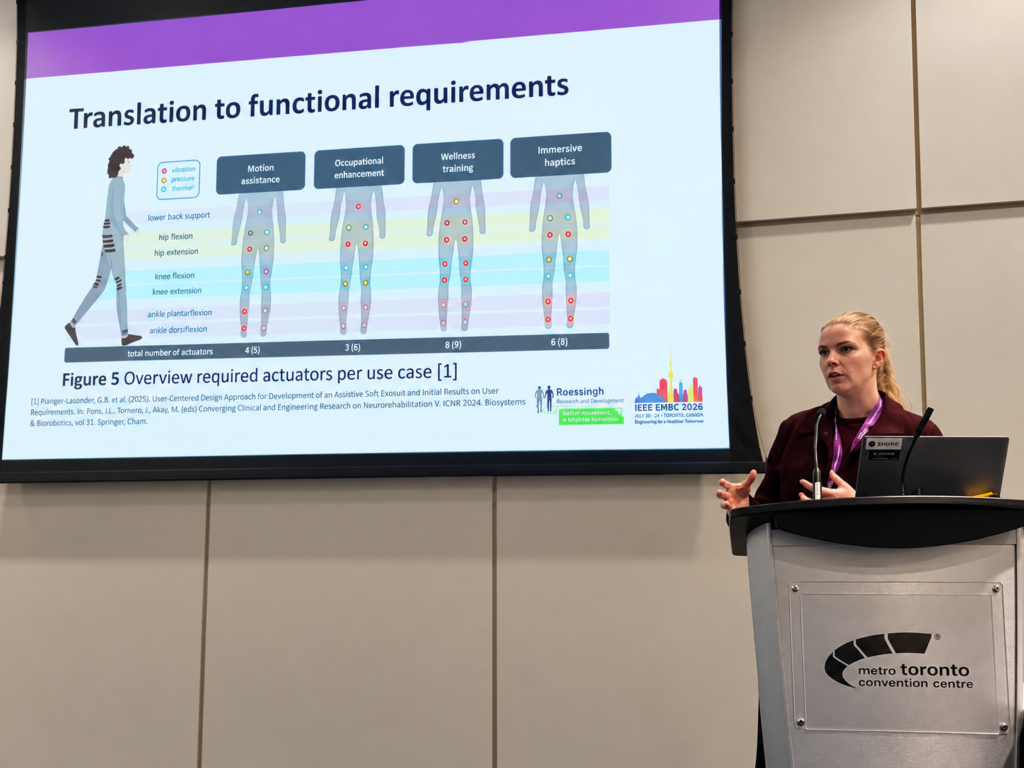
For someone using a wearable robotic device, successful assistance is not measured solely through technical performance. Comfort, ease of use, perceived safety, practicality and acceptance can be just as important in determining whether a technology is suitable for everyday life.
Co-design creates opportunities to identify these priorities early, incorporate different perspectives and continuously refine technologies based on user feedback.
Within SWAG, this approach helps connect the development of soft actuators, sensing technologies and control strategies with the expectations and requirements of the people who may ultimately benefit from them.
It also reinforces a key message: the success of assistive robotics depends not only on what a device can do, but on how well it works for the person using it.
Bridging engineering innovation and clinical reality
Across the four presentations, a consistent message emerged: advancing wearable robotics requires more than improvements in individual technologies.
Soft actuators must work alongside embedded sensors. Sensor information must inform intelligent and responsive control. Biomechanical analysis must guide the assistance provided. And all these developments must be informed by the experiences of users and clinicians.
For SWAG, bringing these elements together is essential to realising its vision of soft, personalised and human-centred assistive garments.
The mini-symposium also demonstrated the value of interdisciplinary collaboration. Robotics engineers, textile researchers, biomechanical specialists and rehabilitation experts bring different forms of knowledge to a shared challenge, helping ensure that technological developments remain connected to meaningful human outcomes.
By bringing these perspectives together at IEEE EMBC 2026, the SWAG consortium contributed to the wider scientific discussion on how wearable robotic technologies can become more adaptable, accessible and relevant to rehabilitation.
As SWAG advances its research, the connection between technological innovation, clinical insight and user-centred design will remain essential to developing wearable robotic assistance that responds not only to human movement, but also to the individual needs of the person wearing it.
SWAG – Soft Wearable Assistive Garments for Human Empowerment has received funding from the European Union’s Horizon Europe programme under Grant Agreement No. 101120408.