
On Thursday, 16 April 2026, BENDABL participated in Future Ready 2026 in Brussels as part of the SWAG project. The event brought together researchers, innovators, industry representatives and policymakers to exchange ideas on how AI, data and robotics can accelerate innovation and strengthen Europe’s technological future. Future Ready 2026 was designed to showcase project outcomes, promote synergies, support exploitation pathways and connect research results with real societal and market needs.

BENDABL’s presence at the event offered an important opportunity to present SWAG within the wider European robotics landscape and to contribute to discussions on the future of human-centred assistive technologies. As a Greek partner in the SWAG consortium, BENDABL is helping advance a new generation of soft wearable assistive garments that aim to support the lower body and core through lightweight, comfortable and intelligent exosuit technologies. SWAG focuses on replacing rigid exoskeleton components with inflatable fabrics and sensing films in order to create wearable robotic systems that are soft, adaptive and nearly invisible under clothing.
SWAG is developing a fundamentally new approach to soft wearable robotics, combining fabric-based actuation, integrated sensing, distributed control and AI-driven user-intent prediction. The project aims to enable personalized real-time motion assistance while improving comfort, safety and usability across applications ranging from occupational support and daily mobility to fitness and immersive experiences. It also seeks to eliminate the need for tethered operation by using a single pneumatic source and a closed pneumatic circuit that efficiently recycles air.
For the SWAG project, BENDABL’s participation in Future Ready 2026 highlighted several important takeaways.
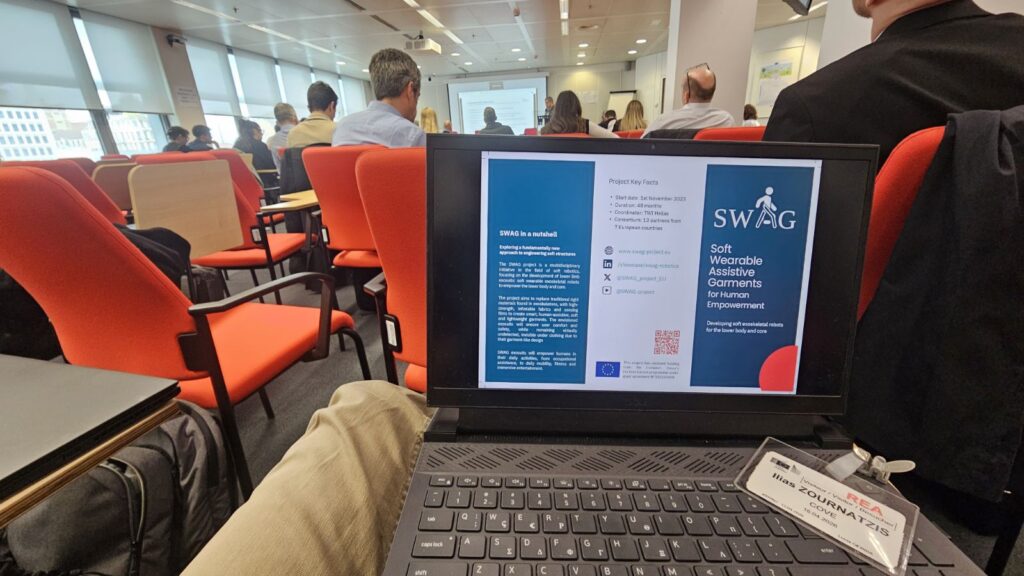
First, human-centred robotics is gaining strong momentum across Europe. Events like Future Ready show that innovation is no longer judged only by technical performance, but also by how well it responds to real human needs. This is closely aligned with SWAG’s vision of assistive exosuits that are not bulky or restrictive, but instead comfortable, wearable and adaptable to everyday life.
Second, soft robotics is becoming a key enabling technology for next-generation wearable systems. SWAG’s approach stands out by moving beyond rigid joint-based assistance and toward full-body-region support through optimized inflatable fabrics, embedded sensing and smart control. This opens the door to assistive devices that are lighter, more ergonomic and more acceptable for long-term use.
Third, collaboration across disciplines is essential to bring wearable robotics closer to real-world deployment. SWAG brings together expertise in soft robotics, smart textiles, materials science, biomechanics, sensing, control and AI. Future Ready 2026 reinforced the value of connecting these technological building blocks with innovation communities, exploitation pathways and broader European stakeholder networks.
BENDABL’s participation also strengthened the visibility of SWAG as a project that is helping shape the future of assistive wearables in Europe. Contributing to the discussion around robotics innovation, user empowerment and scalable impact, the project continues to build momentum toward a new class of wearable robotic technologies designed around the needs of people.
As SWAG progresses, participation in events such as Future Ready 2026 remains important for sharing results, building connections and reinforcing the project’s mission: to create soft, intelligent and truly wearable assistive garments that empower human movement in a safe, effective and unobtrusive way.