
SWAG and SoliDAIR : Robotics Beyond the Lab
The most interesting robotics projects are often the ones focused not only on innovation itself, but on how technology can work in real conditions and respond to real needs.
That is what makes SWAG and SoliDAIR worth looking at together.
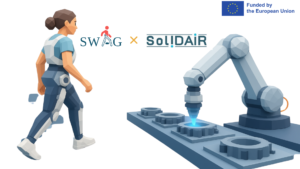
SWAG is developing soft wearable exosuits designed to support the lower body and core through lightweight, garment-like robotics. Its approach combines ambition with practicality, exploring wearable systems that can assist movement in contexts such as occupational support, daily mobility, fitness and immersive experiences. Rather than relying on rigid frames, SWAG works with soft structures, inflatable fabrics, sensing films and intelligent control to create assistive devices that stay closer to the body and closer to everyday use.
SoliDAIR starts from a very different setting: industrial production. Its focus is on helping European manufacturing make better use of AI, data and robotics through adaptable technology building blocks that respond to practical production needs. The project is not simply about introducing more digital tools into factories, but about making those tools valuable in environments where efficiency, quality and working conditions all matter at once.
What makes the two projects interesting side by side is not that they belong to the same niche, but that they reflect how broad the field of robotics has become. In one case, robotics is becoming softer, more wearable and more closely connected to the body. In the other, it is becoming more integrated into industrial decision-making, process control and production realities. Both reflect a wider move towards robotics that is increasingly shaped by practical use.
That shift is important. Robotics is no longer defined only by machines that operate separately from people. More and more, it is about systems designed around the environments in which people actually live and work: movement, fatigue, production pressure, safety, comfort, efficiency and trust. SWAG and SoliDAIR show two different expressions of that development. One is closer to the body, the other to the production line, but both point towards robotics that is becoming more adaptive, more applied and more responsive to context.
Taken together, the two projects also reflect something important about European research today. Innovation is not moving in a single direction, but expanding across a wider landscape in which robotics can be assistive, adaptive, industrial, data-driven and wearable. That broader picture says a great deal about where the field is heading.aptive, industrial, data-driven, wearable and deeply shaped by the realities of use. That is a much more interesting story than a simple idea of “more robots.”
Continue the conversation at the upcoming SoliDAIR webinar
Those interested in how AI, data and robotics are being applied in industrial settings can join the upcoming public webinar hosted by SoliDAIR on 11 June 2026, from 09:00 to 12:00 CEST, online via Microsoft Teams. The session will present key technologies and insights developed throughout the project, with a focus on Visual AI, Data and AI, and Robotics and AI. It will also include interactive Q&A sessions and a featured Brose demonstrator showing how SoliDAIR technologies respond to real industrial challenges. Participation is free. Registrations can be found here.
SWAG will also take part in the wider conversation, making this a good opportunity to follow different perspectives on how robotics and intelligent systems are moving from research into real-world application.
SWAG
SoliDAIR